
Accounting Technology After Accountex 2026: From AI Tools to Better Business Systems
Accountex London 2026 gave a clear view of how quickly accounting technology is moving from standalone tools into everyday finance workflows. Artificial intelligence, automation, reporting tools, compliance platforms and workflow systems were all prominent across the event.
That is not surprising. Accountants, finance teams and business owners are all under pressure to do more with the information available to them. They need faster reporting, better visibility, stronger compliance and more time to focus on the decisions that actually shape business performance.
The risk, however, is that technology can become a distraction. New tools are useful only when they solve a real problem. A business does not become better managed simply because it adds more software. It becomes better managed when its systems help people work more efficiently, understand performance more clearly and take action earlier.
The stronger message from Accountex London 2026 was not that businesses need more software. It was that technology needs to support better systems, clearer information and better decisions.
AI is moving into everyday accounting workflows
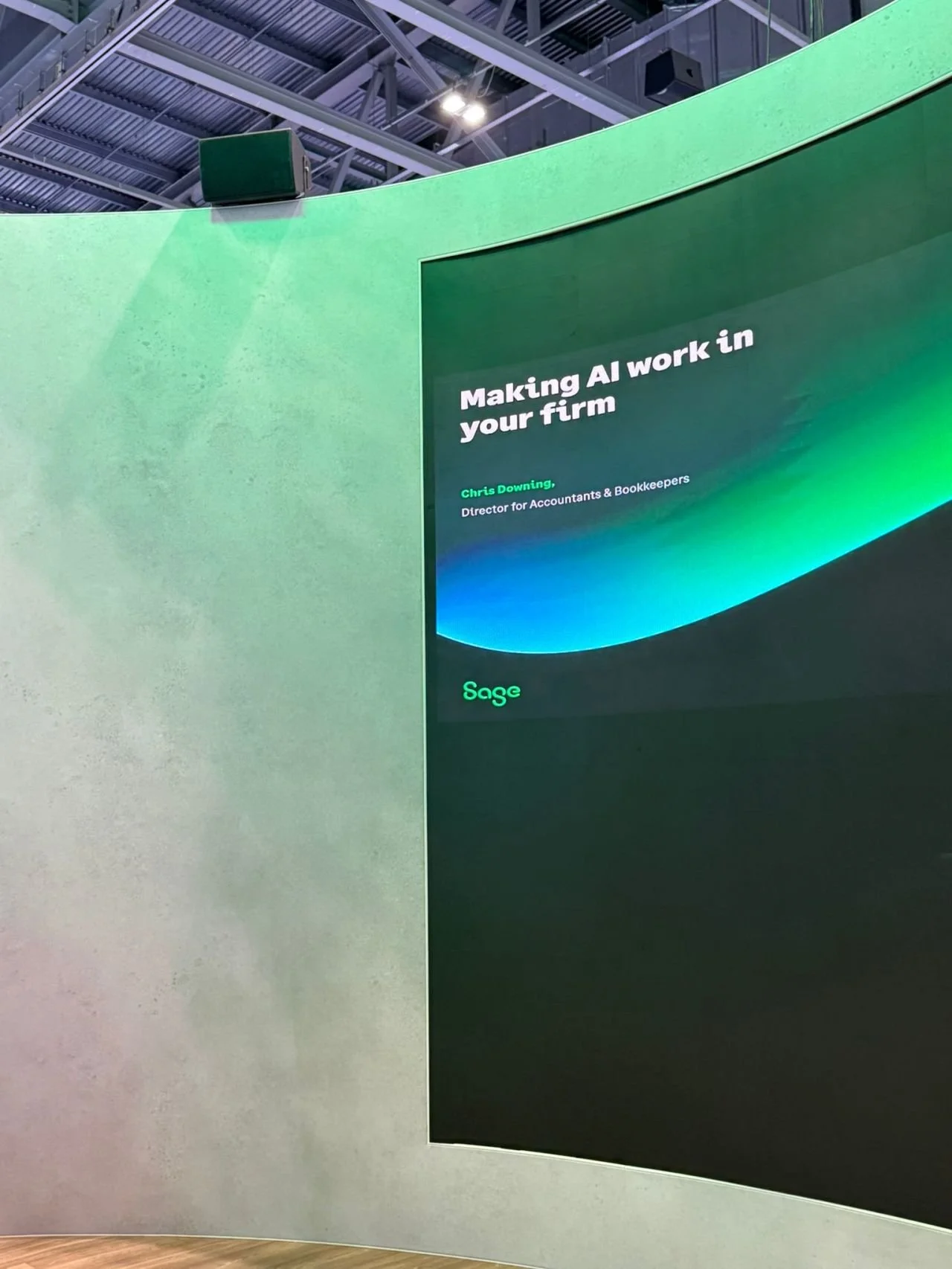
Artificial intelligence was one of the strongest themes at this year’s event. The AI-focused sessions at Accountex London 2026 included topics on AI adoption, automation, governance and the future of accounting work. The event notes also highlighted practical AI use cases such as email automation, meeting notes, variance analysis and internal governance.
The conversation has moved on from whether AI will affect accounting. It already is.
The more useful question is where it can be used safely and productively. Accountex London 2026 included sessions such as The State of AI in Accounting 2026: Trends, Challenges & Opportunities, reflecting the growing focus on practical adoption rather than abstract discussion.
The product launches at the event reinforced the same point: AI is no longer being presented only as a general productivity tool, but as something being built into specific accounting, tax, training and client-management workflows.
For businesses, this is an important distinction. AI may help reduce repetitive administration, speed up analysis and improve workflows. But it should not be treated as a replacement for judgement, review or accountability.
Good financial management still depends on accurate information, clear responsibility and proper checks. AI can support that process, but it does not remove the need for human oversight.
Product launches point to more specialised finance technology
Accountex has long been a place where accounting and finance software providers launch new products. In 2026, several of the product announcements pointed towards a clear trend: tools are becoming more specialised, more automated and more closely tied to defined parts of the finance workflow.
The official product launch coverage from Accountex highlighted platforms including CPDFlow, CleanBooksAI and Hello AI Hub. These are not recommendations, and they will not be relevant to every business or practice. Their value in this context is that they show where the market is moving.
CPDFlow was presented as a CPD management platform for CIMA members, structured around the CGMA Competency Framework. Its focus is not bookkeeping or reporting, but professional development: helping users record, manage and evidence their continuing professional development in a more structured way.
That points to a wider issue for the profession. As technology, tax, reporting and advisory expectations change, learning can no longer be treated as informal or occasional. It needs to be tracked and managed properly.
CleanBooksAI is a different type of example. It was showcased as an AI-powered bookkeeping platform, with tools including Keeva, described as an AI accounting assistant, alongside ZenTax and LedgerLeads. The product details referenced areas such as transaction categorisation, reconciliations, tax reporting, client onboarding and sales automation.
The significance is not simply that AI is being added to bookkeeping. It is that AI is being applied to specific pressure points in the finance workflow, where manual work, delays or inconsistent processes can create problems.
Hello AI Hub, launched by Hello AI Collective, points to another important trend: training and adoption support are becoming products in their own right. It was positioned as an AI learning platform to help individuals and teams move from AI overwhelm to confident, compliant action, with practical training across tools such as Copilot, ChatGPT and Claude.
Accountex also separately promoted the AI Advisory Hub in partnership with Hello AI Collective and Lenovo, focused on practical, no-jargon AI advice for accountants and finance professionals.
Taken together, these launches show that accounting technology is no longer only about replacing spreadsheets or speeding up data entry. It is becoming more embedded in how firms train people, manage compliance, complete bookkeeping, onboard clients, support tax work and adopt AI responsibly.
That specialisation can be valuable. It can also create complexity.
A business or accountancy practice may end up with several different systems, each solving one problem but creating another if they do not work well together. That is why technology decisions need to be made carefully.
The question should not be, “What is the newest tool available?”
The better question is, “What problem are we trying to solve, and will this system improve how we work?”
AI adoption now needs training, rules and review
The launch activity around Hello AI Hub also connects to a wider issue for businesses, accountancy practices and finance teams: many organisations are not short of tools, but they are short of structure.
Staff may already be experimenting with AI to draft emails, summarise notes, prepare reports or review information. Others may be avoiding it completely because they are unsure what is allowed or what is safe.
Uncontrolled use creates one type of risk. Avoidance creates another.
If AI is used without guidance, businesses may face issues around data protection, confidentiality, accuracy and over-reliance on unverified outputs. If AI is ignored completely, businesses may miss opportunities to improve efficiency and reduce repetitive work.
The practical middle ground is governance.
That does not have to mean a complicated policy document. For many businesses, it starts with simple questions:
What tools are approved?
What information should never be entered into an AI system?
Who reviews the output?
Where can AI be used to support work, rather than replace judgement?
How do staff receive training?
How often should the approach be reviewed?
This is where advisers can add real value. Businesses need help separating useful technology from noise, and safe adoption from casual experimentation.
Better reporting still depends on better habits
Many of the tools showcased at Accountex London 2026 were designed to improve efficiency, reporting or workflow. That level of choice is useful, but it can also be overwhelming.
A business may have accounting software, payroll software, CRM systems, payment platforms, spreadsheets, dashboards and industry-specific tools. The issue is often not a lack of data. It is that the data is fragmented, delayed or not being reviewed in a disciplined way.
Better reporting does not come from software alone. It comes from good habits around the software.
That means agreeing what information matters, when it should be reviewed, who is responsible for it and what action should follow. A dashboard that is never discussed is not much more useful than a report that is never opened.
For owner-managed businesses, the priority is often not to add another layer of technology. It is to make better use of the systems already in place.
That might include:
reviewing cash flow forecasts more consistently;
separating profitable and less profitable areas of the business;
tracking debtor days and payment patterns;
monitoring payroll and overhead movements;
reviewing margins before pressure builds;
using management accounts as a planning tool, not only a record of past activity.
Technology can make this easier. It cannot make the discipline unnecessary.
Automation should create time for higher-value work
One of the common promises of accounting technology is that it saves time. That can be true, particularly where systems reduce manual entry, standardise workflows or remove repeated administrative tasks.
However, saving time is only valuable if that time is put to better use.
For finance teams and advisers, automation should create more space for analysis, planning and conversation. It should allow people to spend less time processing information and more time understanding what the information means.
That is especially important for SMEs. In many smaller businesses, financial pressure does not appear suddenly. It builds gradually through slow debtor payments, rising costs, weaker margins, stock issues, staffing pressures or poor pricing.
Good systems can help identify those issues earlier. But someone still needs to look at the information, ask the right questions and decide what to do next.
The value is not just in automation. The value is in what automation makes possible.
What businesses should take from Accountex 2026
The technology emerging from Accountex London 2026 points to a clear direction. Accounting systems are becoming more automated. AI is moving into normal workflows. Professional development, compliance, reporting and client management are becoming more systemised.
For businesses, the response should be practical rather than reactive.
There is no need to chase every new product. There is, however, a need to review whether current systems are supporting the business properly.
A useful starting point is to ask:
Are we getting timely financial information?
Are we using that information to make decisions?
Are our systems reducing manual work or creating more admin?
Do we understand where AI could help and where it could create risk?
Are our reports clear enough to support planning?
Are we reviewing margins, cash flow and overheads often enough?
Are we using our accountant or adviser as a source of insight, not just compliance support?
These questions are not about technology for its own sake. They are about control, clarity and better decision-making.
The real value is in the system, not the software
Accountex London 2026 showed a technology market that is moving quickly. New products are being launched. AI is becoming more practical. Automation is becoming more embedded. Finance professionals are being offered more tools than ever before.
But the central point remains simple.
Software is only useful when it supports a stronger way of working.
For some businesses, that may mean adopting a new reporting tool. For others, it may mean improving how existing systems are used. In many cases, the biggest gains will come from clearer processes, better review habits and more focused conversations around the numbers.
Technology can help produce information faster. The real value comes from turning that information into action.
If you would like to review whether your current systems are supporting better business decisions, please get in touch with our team.